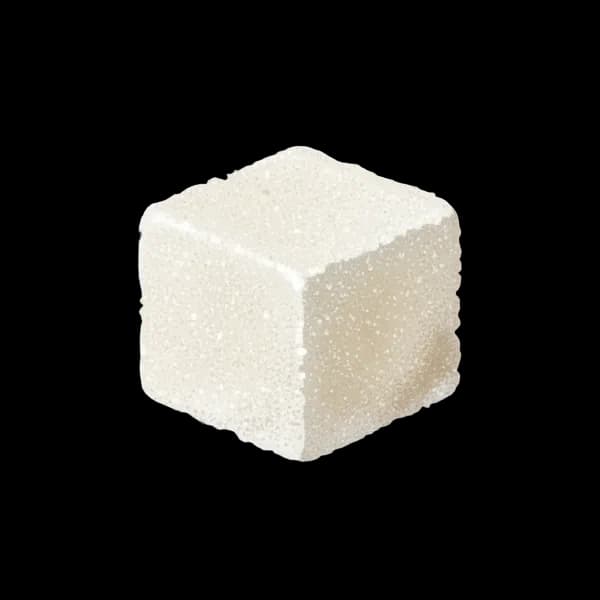
Sugar cube is a small pressed block of white refined sugar, formed for single-portion sweetening and roughly equivalent to one teaspoon of granulated sugar.
A hard, dry crystalline solid that dissolves to clean, straightforward sweetness; white cubes are essentially odourless with no flavour beyond sugar, while demerara versions add a faint molasses note.
Bartenders muddle a cube with a splash of water and bitters into a paste before mixing, since undissolved crystals will not combine with chilled spirit and preparation takes longer than with ready syrup. In a sparkling-wine build the cube is dropped in whole and left undissolved, where it slowly dissolves and nucleates a continuous stream of bubbles — a physical effect a pre-dissolved sweetener cannot reproduce. It works as an accent-level sweetener, dosed one cube at a time.
Any equivalent quantity of sucrose in another form — granulated or caster sugar, or simple syrup — matches its sweetness, since it is the same molecule and only the delivery format differs; the one case a swap fails is where the solid, slowly-dissolving cube is needed to nucleate bubbles in a sparkling drink.
A sugar cube is solid crystalline sucrose that must be dissolved in the glass, whereas simple syrup is sugar already dissolved in water; muddling a cube with water and bitters effectively produces hand-made syrup in situ.
Granulated white sugar is dampened with a little sugar syrup or water, pressed into a mould and dried so it holds a solid cube shape. The sugar is nearly pure sucrose — above about 99.7% — a disaccharide of glucose and fructose refined from either sugar cane or sugar beet, the two sources being chemically indistinguishable. Brown or demerara versions carry or are coated with molasses for colour and flavour.
The sugar cube and the press to make it were invented in 1843 by Jakob Christof Rad, director of a sugar refinery in Dačice, Moravia (then the Austrian Empire, now the Czech Republic), who patented a machine for cutting large block sugar into uniform pieces.